Supports for Success

Helping Ontario’s Youth Thrive

Ontario’s youth are more diverse, educated and socially engaged than ever before, and in many ways are well positioned to succeed in today’s complex society. Unfortunately, not all young people are able to realize their potential. Some are unemployed or have precarious jobs. Some have mental health and addictions issues. Some experience racism and discrimination. Some are homeless. About 1 in 10 are not employed, in training or enrolled in education. This statistic is much higher for youth who are marginalized, such as those who are low-income, racialized, or Indigenous. Such inequities can start before birth and build over the life-course, resulting in negative health outcomes and the inability to thrive.

We know a lot of work is being done within the many sectors that support children and youth, but now is the time to move upstream and tackle the systemic root issues. Evidence shows that the earlier we invest, the better children do throughout their lives, and the greater their gains are in health and equity.
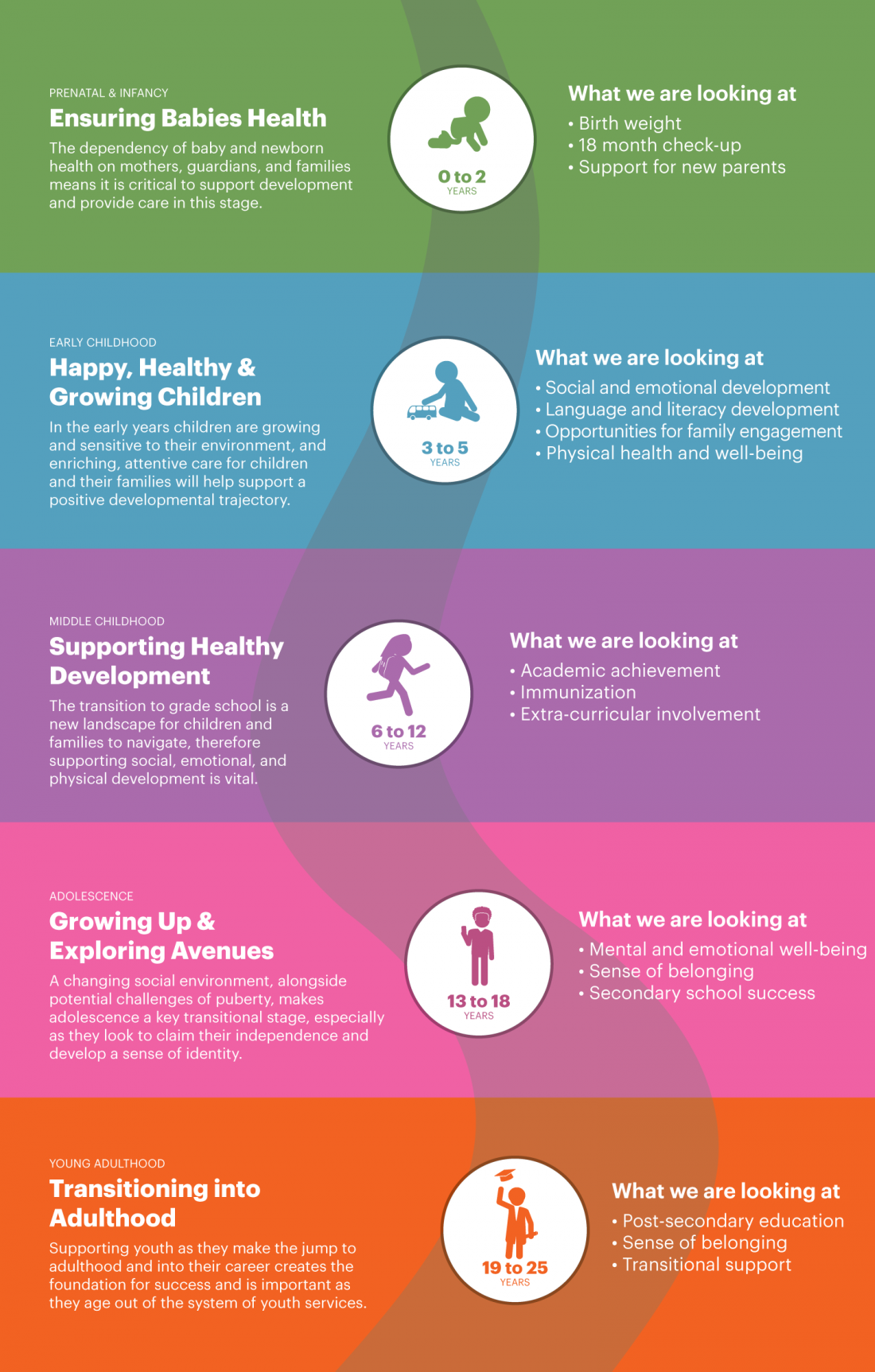
 

Supports for success infosheet thumbnail
From birth to employment

Supports for Success (SFS) is an initiative geared towards improving educational, economic and social outcomes for marginalized children and youth in Ontario. SFS hopes to ignite a process where circles of providers, funders, and community members can drive coordinated action that improves inequities at each key life-stage from birth to employment. For the purposes of SFS children and youth are defined as those between the ages of 0-25 years. We are collecting data about children and youth in four communities in Ontario and we are sharing this information to strengthen sustainable and community driven solutions across the province.

SFS in the community

SFS has engaged communities and stakeholders throughout the research development process to help ensure we generate research that speaks to the unique issues and concerns facing each community. We conducted research in four sites that represent a cross-section of Ontario: Brant County, Thunder Bay, East Scarborough, and the Kingston, Frontenac and Lennox & Addington region (KFL&A). We have a Community Researcher and Community Engagement Lead in each community to facilitate and foster meaningful engagement with community members throughout the project. We have also partnered with Indigenous researchers, Elders, and Knowledge Keepers to support us in designing an approach that is informed by Indigenous community practices, knowledge, and values.

The outputs

The following table illustrates the main components of the SFS project

Research ActivitiesDescriptionPurpose
Community ProfilesA compilation of demographic information and key indicators of social, economic, educational and health markers that are predictive of success across each SFS site that extend across each SFS site toTo provide data that can offer potential direction for future Collective Impact initiatives, such as specific outcomes that various actors will work to improve.
Social Network AnalysisA method of collecting and analyzing data from multiple individuals, programs or organizations that may be interacting with one anotherThe unit of analysis is the relationships between entities and within the networkTo gain an understanding of the connections between organizations that service children and youth, including referral processes and potential gaps in services across the life course.
Programs InventoryAn up to date list of programs and services that are available for children and youth in each SFS siteThis inventory includes information from existing provincial databases like 211 as well as other sourcesTo provide a more robust list of programs and services as a tool for community members and policy makersTo identify service sectors or life stages that need more programs
Interviews, Focus Groups, and Indigenous Talking CirclesInterviews were conducted with service providers and community leaders across all four sitesFocus groups and Indigenous Talking Circles were conducted with caregivers and youth across all four sitesTo better understand the experiences, success strategies, and challenges of families, children, youth, and service providersTo ensure community members and users of the system have a voice in shaping policy recommendations
Moving forward

We will use the evidence gathered through our research to engage key stakeholders in Ontario to rally around Collective Impact. Collective Impact involves diverse stakeholders coming together to achieve a single set of goals with common measurements. This approach has been extended to address the gaps in health and social support that can act as barriers for children and youth. The Collective Impact strategy described above will be tailored to suit needs each community, build off local strengths, and be designed to align with existing local initiatives.

SFS is a project of Wellesley Institute, funded by the Ministry of Advanced Education and Skills Development (MAESD), and aligned with the provincial Collective Impact for Disconnected Youth (CIDY) initiative. We are also partnered with the Waakebiness-Bryce Institute for Indigenous Health and the Centre for Citizenship and Community at UCLan in the UK.

Local teams are leading research and engagement in each community site, with management and coordination from a central team at Wellesley Institute in Toronto. Wellesley Institute works in research and policy to improve health and health equity in the GTA through action on the social determinants of health.

Reports and Videos

SUMMARY

EAST SCARBOROUGH COMMUNITY REPORT

BRANTFORD AND BRANT COUNTY COMMUNITY REPORT

KINGSTON, FRONTENAC, LENNOX & ADDINGTON COMMUNITY REPORT

THUNDER BAY COMMUNITY REPORT